
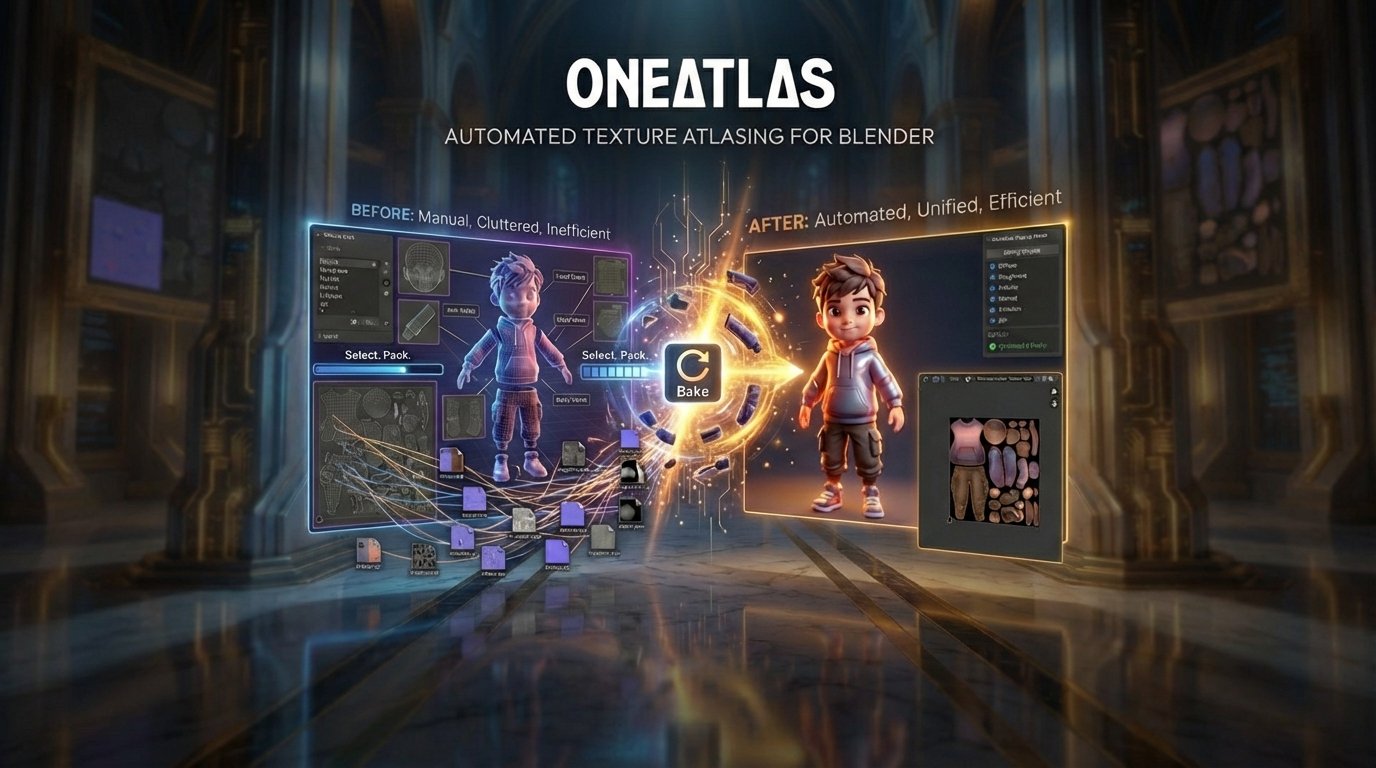
OneAtlas
One-click texture atlas baking for Blender. Automatically combines multiple single-material objects into a single optimized atlas mesh.
OneAtlas | Texture Atlas Baking Made Simple
OneAtlas transforms Blender scenes containing multiple single-material objects into single, optimized atlas objects with a guided workflow. No destructive edits. No UV chaos. No texture management headaches.
Select your objects → Click ONE ATLAS → Arrange UVs → Bake → Get a clean, atlas-textured mesh.
What This Add-on Solves
Manual texture atlas creation usually means:
- Creating new UV maps for each object
- Manually arranging UV islands to avoid overlap
- Setting up complex baking configurations
- Managing multiple image textures
- Joining meshes and fixing materials
OneAtlas handles the entire pipeline automatically and safely on temporary copies of your objects. Your original scene stays untouched.
Perfect For
- Game asset optimization & reducing draw calls.
- Mobile and WebGL (Three.js/PlayCanvas) exports.
- Texture memory optimization.
- Combining multiple single-material objects into a single atlas material.
Key Features
Guided Workflow
Step-by-step process from selection to final atlas mesh. Minimal friction, maximal results.
Original Backup
Original objects are automatically hidden using View Layer exclusion. Never modified, always safe.
Smart UV Packing
Scales to fit, allows 90° rotation, and finds the most efficient layout using iterative packing.
UV Memory System
Save manual UV layouts for objects and restore them instantly by Name or Topology match.
Multiple Texture Types
Bake Diffuse, Roughness, Metallic, Normal, Emission, and Ambient Occlusion in one go.
Dual Panel Access
Access OneAtlas from both the 3D View and UV Editor sidebars for a seamless workflow.
Auto Texture Handling
Auto-saves textures as high-quality WebP files in a dedicated folder. Works with packed textures natively.
Documentation
Installation
- Download the addon as a ZIP file
- In Blender, go to Edit > Preferences > Add-ons
- Click Install and select the ZIP file
- Enable the addon by checking the box next to "OneAtlas"
Workflow Steps
- Select Objects - Select single-material mesh objects in 3D View.
- Start Process - Click "One Atlas" (Working copies are created in a new collection, originals hidden).
- Arrange UVs - In the UV Editor panel, use Auto Pack All or arrange manually.
- Save/Load Memory (Optional) - Save your perfect layout or apply a previously saved one.
- Mark Done - Click "UV Work Done - Proceed to Bake".
- Bake Textures - Click "Bake Textures" in the 3D View panel.
- Finalize - Join objects into a single mesh with the atlas material applied.
Technical Details
- Blender: 4.0.0 or higher
- Render Engine: Uses Cycles for baking
- Workflow: Fully Non-destructive
- Location: View3D > Sidebar > OneAtlas, UV Editor > Sidebar > OneAtlas
Tips for Best Results
- Single Material per Object: For best results, ensure each selected object has a single material assigned before running OneAtlas
- Save your Blend file before baking (required for auto-saving textures)
- UV Margins: Use a margin of 0.01 or higher to prevent texture bleeding between objects
- Resolution: 2048px is a good balance for most game assets
- UV Memory: Use Topology match if you've renamed your objects but kept the mesh same
UV Packing Options
- Scale to Fit: Scales each object's UVs to fill their allocated grid cell completely
- Allow 90° Rotation: Rotates UV islands for better space utilization
- Iterative Packing: Tests multiple layouts to find the most efficient UV usage
- Margin Control: Adjustable gap between UV islands to prevent texture bleeding
Changelog
- WebP Texture Format: Textures are now saved as .webp, significantly reducing file size while maintaining quality.
- UV Memory System: Added 'Save UV Memory' and 'Apply UV Memory' buttons. Restore by Name or Topology match.
- Iterative UV Packing: New smart packing algorithm that tests multiple bin sizes for maximum UV scale.
- View Layer Backup: 'Backup Originals' now uses View Layer exclusion for better Outliner control.
- Optimized Defaults: Default texture resolution set to 2048 and baking set to Diffuse Only by default.
- Material Cleanup: Final baked material now defaults to Roughness 0.8 for a better visual starting point.
- Added Backup Originals option to hide original objects using collections.
- Added Scale to Fit option for specialized UV packing.
- Added Allow 90° Rotation option for better UV space utilization.
- Materials are now copied to prevent modifications to original materials during the baking process.
- Dual panel interface across 3D View and UV Editor.
- Enhanced UV packing with grid layout algorithm.
- Working copies system (fully non-destructive workflow).
- Smart material and shader node setup for the final atlas.
- Initial Release: Multi-object texture atlas baking.
- Support for major PBR maps (Diffuse, Roughness, Metallic, Normal, etc).
- Full support for Blender 4.0+ extension format.
Quick Start Guide
Select Objects
Select the mesh objects (each with a single material) you want to combine into an atlas.
One Atlas
Click 'One Atlas' to create working copies and hide originals.
Pack UVs
Arrange your UV islands in the UV Editor panel.
Bake & Finalize
Proceed to bake textures and join into a single optimized mesh.
Frequently Asked Questions
?Does OneAtlas modify my original objects?
No. OneAtlas is completely non-destructive. It creates working copies of your objects in a separate collection and hides the originals using View Layer exclusion. Your source objects remain untouched.
?How should materials be assigned for baking?
For optimal baking results, make sure each selected object has a single material assigned. OneAtlas then seamlessly combines these multiple objects and materials into a single texture atlas.
?Which texture types are supported?
OneAtlas can bake Diffuse (Base Color), Roughness, Metallic, Normal (Tangent Space), Emission, and Ambient Occlusion (AO). You can choose which maps to bake in the 3D View panel.
?What is the UV Memory System?
The UV Memory System allows you to save manual UV layouts and restore them later. It can match objects by name or by topology (loop count), which is perfect for duplicated objects or iterative workflows.
?Does it work with packed textures?
Yes, OneAtlas has native support for packed textures. It will automatically handle internal textures without needing you to manually unpack them before baking.
?What format are the baked textures saved in?
Textures are saved in high-quality WebP format by default. This provides excellent visual quality with significantly smaller file sizes compared to JPG or PNG.